
As It Is
By this point in the week, many of us feel the weight of the wider world pressing back in.
The headlines don’t pause for Christmas.
Wars don’t stop because we gathered.
Climate anxiety doesn’t soften because the table was set.
Injustice doesn’t take a holiday.
And somewhere between Boxing Day leftovers and returning notifications, a familiar question rises: What difference does any of this make?
What does it matter that I cooked a meal, rested, showed up, lit a candle, tried to be kind — when the world is still burning?
It’s an understandable question. And it’s one that can quietly erode our capacity to care if we’re not careful.
There’s a particular kind of despair that tells us small goodness is meaningless unless it fixes everything. That unless our actions scale to the size of the problem, they don’t count at all.
But that logic is part of the harm.
It asks us to abandon our humanity in the face of complexity.
It confuses scale with significance.
It mistakes spectacle for substance.
bell hooks writes,
“Love is an action, never simply a feeling.”
And actions, real ones, are always specific. Located. Embodied. They happen somewhere. To someone. In time.
Small goodness is not naïve.
It is how we refuse numbness.
It’s easy to dismiss everyday care as insufficient when the problems are vast. But systems don’t fracture because people stop making grand gestures; they fracture when people stop tending to one another at all.
Small goodness is how we stay in relationship with the world… not as saviours, not as spectators, but as participants who refuse to harden.
This is not about pretending your actions are enough to solve everything.
They aren’t.
But they are enough to keep you human.
And that matters more than we’re often taught to believe.
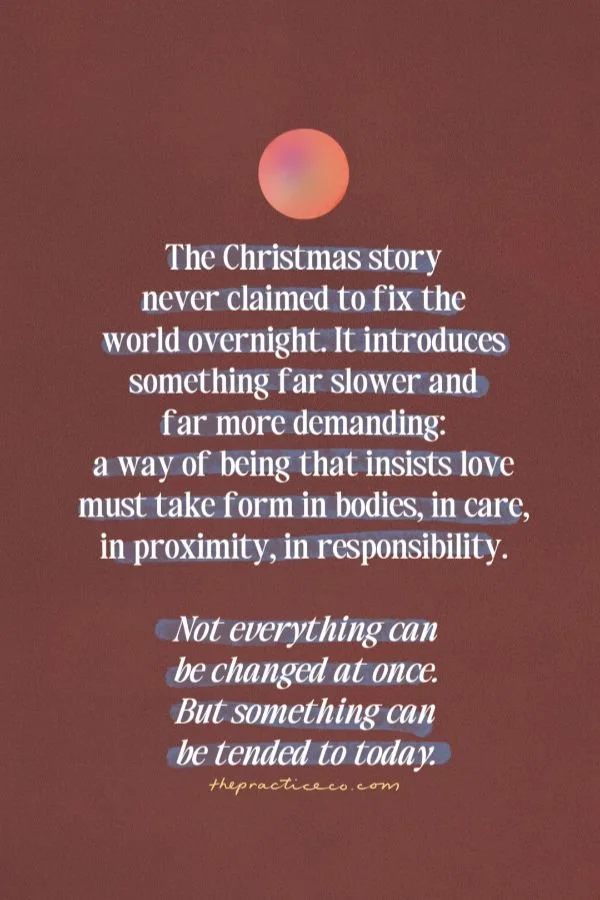
The Christmas story never claimed to fix the world overnight. It introduces something far slower and far more demanding: a way of being that insists love must take form in bodies, in care, in proximity, in responsibility.
Not everything can be changed at once.
But something can be tended to today.
A conversation that stays respectful instead of sharp.
A boundary that protects your nervous system.
A choice not to dehumanise someone, even when it would be easier.
A refusal to scroll past suffering without letting it touch you.
A moment of rest that keeps you from burning out entirely.
Small goodness does not ask to be applauded.
It asks to be practised.
This is where so much spiritual language goes wrong — when it turns goodness into an outcome instead of a posture. When it asks us to measure worth by impact rather than faithfulness.
You are not responsible for carrying the whole world.
But you are responsible for how you live within it.
And choosing to live with care - deliberately, imperfectly, persistently - is not insignificant. It is how moral imagination survives. It is how compassion stays intact. It is how futures remain possible.
The temptation is to either collapse into despair or inflate ourselves into heroes. But there is a quieter, sturdier path between those extremes.
It looks like showing up without illusions.
It looks like acting without guarantees.
It looks like goodness that is small enough to be real.
In a world that overwhelms us with scale, choosing care is not retreat.
It is resistance.
Small goodness still counts.
Not because it fixes everything —
but because without it, nothing good endures.
CONSIDER THIS: What small act of goodness feels possible for you today? Not heroic, not exhausting, just honest? Let that be enough.
Liz Milani, xo