
Reclaiming Loaded Words
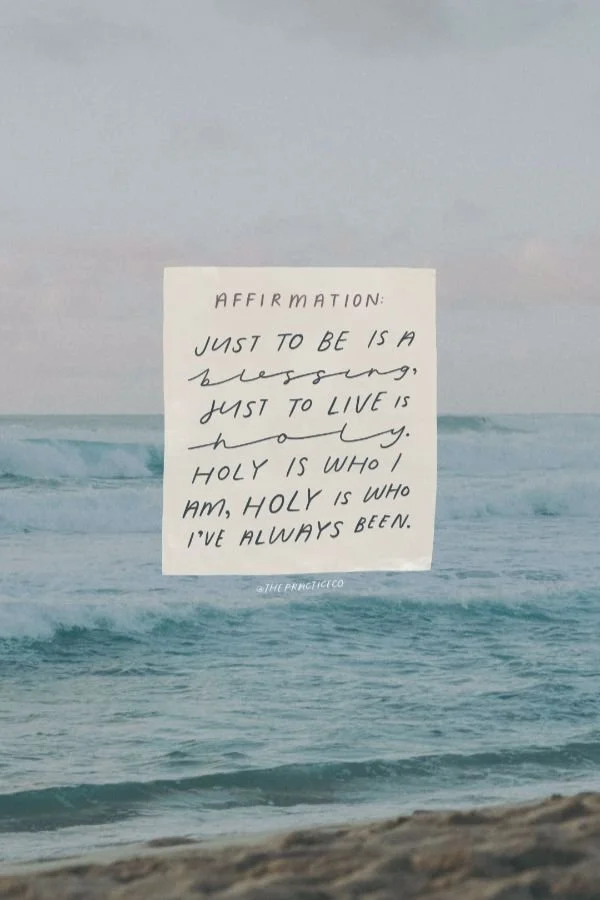
A reclamation of the word: Holy.
If the idea of being holy has been used as a dangling carrot, held out in front of you to behave and perform, obey and assimilate, to try to reach an impossible standard of goodness and belonging, take heart.
Holiness is not something you can achieve. Holiness is not a sacred place far away from here that you can only get to by accomplishing great feats of faith. Holiness is not absent from humanity, waiting for you in a realm beyond this one. Holiness is not beyond this realm; it is not beyond you… holy is who you are; holiness is your natural state of being.
One of the Ten Commandments stated in the Hebrew Bible is:
"You shall not take the name of the Lord your God in vain for the Lord will not hold him guiltless who takes His name in vain."*
Jesus told his friends to pray by saying:
"Our Father in heaven, hallowed [holy] be your name." *
And we've been taught that these verses are so because holiness is separate from the ordinary, and only God is holy, and we must take care to separate the ordinary from the holy.
In the ancient world, your name was everything: your identity, your essence, and reputation. The higher goal was to have a good name, over wealth and riches. So when we say that God's name is Holy, we're making a statement about the identity, essence, and reputation of the Divine. God's name isn't just a label; it carries the story of who God is and what God does. It's permeated with not just the idea of goodness, but the essence of it.
Jesus went on to say:
"Your kingdom come, your will be done, on earth as it is in heaven."
God is holy, but God doesn't want to remain separate in God's holiness. "On earth as it is in heaven" is about the joining of the sacred and the human, a uniting of the holy and the ordinary.
Or we could take that further…
Abraham Heschel said:
"Just to be is a blessing.
Just to live is holy."
As the creation poem described, as all things were created, before they were given any other name, God called all things by their foundational nature:
good.
If we go back to Exodus, and the command to not use God's name in vien, in Hebrew, the scripture reads:
"You shall not carry the name of the Lord your God in vain."
This has nothing to do with using God's name as a swear word… It more or less says, do not live as though you do not carry something holy within when you do. Because you do, it's about the names you allow yourself to be called. It's about how you embody your foundational nature, how you carry the name of the Lord in the very fabric and fibres of your being.
Richard Rohr said:
"Everything is holy for those who know how to see.
In authentic mystical moments, any clear distinction between the sacred and profane quickly falls apart. One henceforth knows that all of the world is sacred because most of the time such moments happen in secular settings. Our Franciscan official motto is Deus Meus et Omnia—"My God and all things." Once you recognize the Christ as the universal truth of matter and spirit working together as one, then everything is holy. Once you surrender to this Christ mystery in your oh-so-ordinary self and body, you begin to see it every other ordinary place too. As St. Bonaventure, the philosophical interpreter of Francis, said (quoting Alan of Lille), "Christ is the one whose center is everywhere and whose circumference is nowhere."
So, my love, do away with those contrived and un-true ideas of holiness being a far of thing in a far off place that you can never be, because the truth is, you have always been holy, the only thing in your way is your willingness to see it.
AFFIRMATION: Just to be is a blessing, just to live is holy. Holy is who I am; holy is who I've always been.
* Exodus 20:7, Matthew 6:9, Matthew 6;10