
Begin Again, Again, Again
Doubt tends to show up when you’re about to change something, or step out, or start something new, or just make a left turn. It doesn’t sound like this might not work. It sounds like who do you think you are.
It’s a voice that questions whether you’re qualified to do what you’re doing. Whether you have any right to start something new. Whether you’re just dressing up the same insecurities, patterns and ideas in new clothes and calling it growth. Whether you’re playing pretend at being whatever it is you’re trying to be: a writer, a parent, a partner, a person with anything to say, something to do, things to bring to the table of the community.
It took me a long time to understand that this voice wasn’t telling me the truth. I used to think it was the necessary critic I needed to keep me on track, to keep me humble, to keep me honest. I thought the discomfort that voice brought was diagnostic. The right move was to either prove it wrong by working harder, or listen to it and stay small.
The fake feeling is loudest in the gap between who you were and who you’re becoming. When the old shape no longer fits and the new one hasn’t quite emerged. It convinces you that the gap is evidence of your inadequacy, when in fact the gap is just what beginning again looks like from the inside. You haven’t failed. You’re just in the part nobody photographs.
Rilke wrote, in the Sonnets to Orpheus:
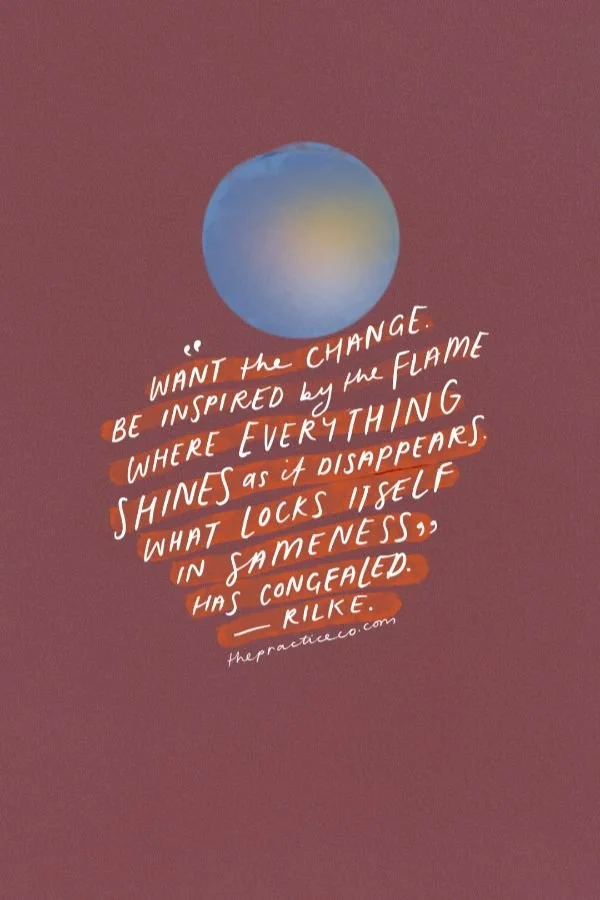
“Want the change. Be inspired by the flame where everything shines as it disappears. What locks itself in sameness has congealed.”
I’ve written a lot about integrity. I grew up in a community where we were taught to read sameness as integrity — where being unchangeable and unshakeable was the virtue. But Rilke is telling us that sameness, past a certain point, isn’t integrity at all. It’s a stiffening. A loss of the living thing. Sameness congeals and stagnates.
There’s a related feeling worth naming, because it’s been one of the strongest forces keeping me in places I should have left. Economists and psychologists alike call it sunk cost bias. It says: I’ve already put so much into this, I’ve given it everything. I can’t walk away now. The years already given become the reason to give more years. The losses already absorbed become the reason to absorb more losses. I can’t change now. I’ve come too far.
But sunk cost isn’t a reason to stay. It’s just a feeling trying to convince you not to go. The money is already spent. The years are already gone. None of that determines what the next year should look like. We stay in things we should have left because we can’t bear the thought that all that prior investment was for something we’re now walking away from. The investment gets mourned as if it were a contract. It wasn’t a contract. It was a stretch of your life. It doesn’t have to keep happening. The grief of all those years sits heavy in me still. I bet you’ve felt it in your own way, too.
The fake feeling and the sunk cost feeling aren’t random personal failings. They’re not bugs in your system that need fixing through more therapy or more confidence. They’re doing work for something larger than you.
Pauline Rose Clance, the psychologist who coined the term imposter syndrome with Suzanne Imes in 1978, said:
“If I could do it all over again, I would call it the imposter experience, because it’s not a syndrome or a complex or a mental illness, it’s something almost everyone experiences.”
The woman who named the phenomenon wished she’d named it differently. The syndrome framing made it sound like an illness inside a person, when really it’s a common, almost universal experience of being human in motion.
And the longer I sit with it, the more I think the feeling is doing structural work for the cultures that produced us.
It’s how the cultural script keeps you in place. If you stay the same, the systems around you stay legible. Your value is predictable. Your role is clear. The people who built their relationships with a particular version of you don’t have to renegotiate. The script that tells you once you find the thing, you do it forever requires the fake feeling to enforce itself. Without it, you would simply keep moving when moving was true. The fake feeling is what the system charges you for the audacity of beginning again.
I’m not saying the feeling isn’t real. It is real. I’m saying it isn’t yours. It was given to you by a culture that needs you to doubt your own evolution in order to keep producing what it needs you to produce.
You’re not a fraud for changing. You’re not failing at being yourself. You’re engaged in the ongoing work of creating you and your life every day, over and over again.
LISTEN: The voice that asks ‘who do you think you are?’ every time you try to grow wasn’t born in you. It was put there by a system that needed you to stay small.
L xo