
Jesus wasn’t killed for your sin…
Normal life is happening over here.
Coffee going cold while I answer emails. The dog circling my feet with the energy of someone who has never once been taken for a walk and cannot believe this injustice is continuing. Kids out the door. The café doing its thing. The world outside doing its thing, which lately feels like a lot.
I don’t know about you, but I’ve been living in a particular kind of tension lately. The tension of trying to stay steady… for myself, for the people around me, while being honest about the fact that everything outside feels like it’s shifting. Not catastrophising. Not pretending. Just holding both. The ordinary life and the weight of it. The coffee and the news. The dog and the cabinet meeting.
It turns out this tension has a name. And it’s older than any of us.
This Easter I’ve been sitting with the Jewish context of Passover week again, something I return to often in my work, because the more you understand what Jerusalem actually looked like that week, the stranger and more human and more alive the story becomes.
And this year, something landed differently.
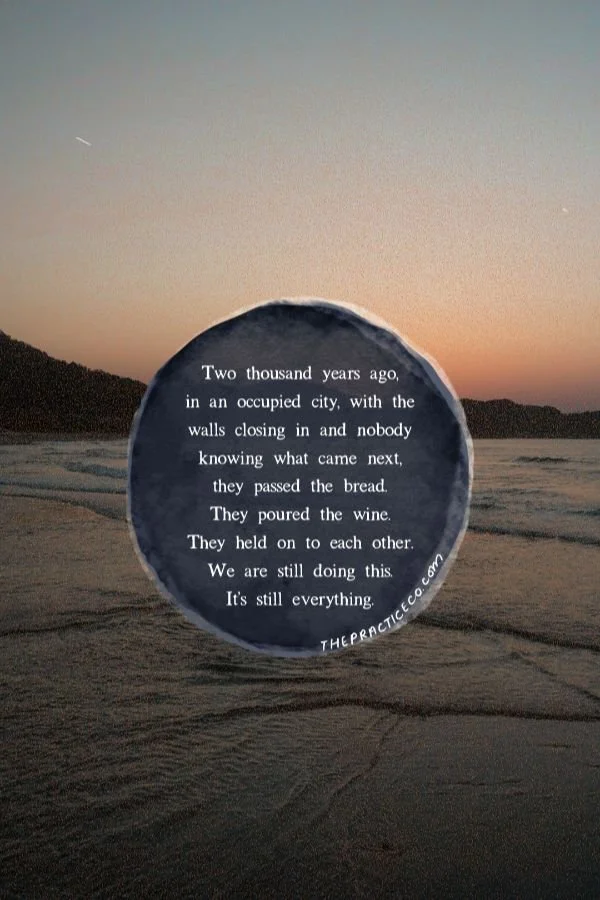
Jerusalem that week was a city of three hundred thousand people packed into walls built for a fraction of that number, all gathered to celebrate a liberation festival under Roman occupation, with soldiers watching from fortress walls and every faction in the country holding a different vision of what freedom should look like. The ground was crackling. The hum of collective anxiety and longing was everywhere.
And the people living inside it; the disciples, the crowds, the ordinary families trying to get through the week… they didn’t know they were living inside a hinge moment in history. They just knew something was shifting. That the world they’d been handed was becoming strange. That the old certainties were losing their grip and nothing reliable had arrived to replace them.
Sound familiar?
Here’s what I want to say about Easter, plainly, after sitting with all of this.
We were handed a small version of the story. A controlled, manageable version that made it about our sin, our debt, our inadequacy requiring cosmic settlement. A version that kept us compliant and dependent and convinced that our direct experience of the sacred couldn’t be trusted without someone else mediating it for us.
But that’s not the whole story. And the part that was left out changes everything.
Jesus wasn’t killed because of your sin. He was killed because he was dangerous… Not violent, not armed, but something harder to manage than violence. He was free. Genuinely, visibly, unmanageably free. Free from the need for approval, free from the fear of the powerful, free from the performance of religiosity that kept the institution running smoothly. And a person who cannot be controlled, who will not perform the assigned role, who keeps telling the truth in rooms where the truth is inconvenient… that person becomes a threat to every system that depends on compliance.
So they killed him.
Not as a cosmic transaction. As a very human, very political, very predictable response to a person who refused to stop being free.
And then (and this is the part that keeps stopping me) on the Saturday he lay in the tomb, in every synagogue across Jerusalem, the ancient reading for that day was Ezekiel 37. The valley of dry bones. The question that is either the most absurd ever asked or the most important: can these bones live?
The calendar knew something the people didn’t.
It usually does.
This Easter I wrote a seven-part series called The Turning. It drops today (Monday) on Substack and in the App, and runs through Easter Sunday, one piece a day, each one standing alone, each one asking something real of you.
We’re going to sit inside the Thursday night meal and what it actually was. We’re going to stand in the occupied city and feel the hum. We’re going to meet the Jesus nobody preached… the subversive, dusty-footed one who kept showing up for the wrong people in the wrong places. We’re going to live in the long Saturday, the not-yet, the dry bones. We’re going to look at the cross without the transaction theology and find something truer underneath it. We’re going to talk about what comes back. And on Sunday we’re going to arrive somewhere that isn’t triumphant and isn’t resolved but is, turned. Quietly, irrevocably, turned.
The series is for anyone who still feels something at Easter but doesn’t quite know what to do with it. For anyone living in the in-between, and I think that’s most of us right now. For anyone who was handed a small version of this story and suspects, somewhere in their bones, that there might be a bigger one.
The story is bigger than the box it was handed to you in.
It always was.
The Turning - out now in the App. See you there.
Always, L xoL xo