
Rage, Anger, Repeat
Anger, madness, rage. Valid. Real. Human.
And yet — I can already hear the questions rising.
What if I sin? What if they lead me astray? What if my rage makes me hurt someone? What if I end up making a bad choice? What if this doesn’t go well for me?
Yeah. I get that. Totally.
But let me ask you this: how is not feeling your feelings working out for you?
Emotion is energy, and all energy needs to flow. It needs somewhere to go. Stuck energy becomes disruptive, stagnant. When we suppress our feelings, we compress them. We change their structure and shape. And in that dark pressed place, they become something else entirely — something harder to name and harder to move.
So underneath all those questions is a more honest one: how do I stay safe when I’m feeling something that doesn’t feel safe?
Dr Victoria Lemle Beckner, clinical psychologist and Associate Clinical Professor at UCSF, writes in Psychology Today:
“Our initial emotional response is often a complex jumble of primary feelings (that reflect what’s actually happening), plus secondary emotions (often related to distorted interpretations), mixed together with all of our avoidance behaviours. We have to develop the muscle and courage to stay with this uncomfortable welter of emotions in order to unpack what is important and meaningful. I often help clients visualise their initial emotional reactions as the ‘surface waves’ of an ocean. We need to ride these choppy waves, while holding our thoughts and interpretations lightly, in order to slowly drop into deeper emotional waters where the felt-sense of our values reside.”
And just like waves on the surface of the ocean rise and fall, come and go, vary in intensity and shape — no feeling is final. Remember that.
Feeling your feelings is what gives you access to your values. If you don’t allow yourself to get curious about what you feel, to let the feeling have its voice, you won’t be able to get to what’s beneath it. And what’s beneath it is vital.
I know. It still feels risky. Unsafe. Anxiety-inducing. And isn’t it interesting that we have feelings about our feelings.
Here is a practice I use when it gets difficult. Start by naming what you’re feeling. This might take a few attempts — what initially presents as anger might, when you look closer, turn out to be fear, or doubt, or grief. Take your time. Say it out loud if that helps. Write it down.
Then allow the sensations that arise in your body. Feelings are called feelings because we feel them. Your body is not separate from this process — it is the conduit. Let the sensations be present. Let them rise and fall. If you get pulled into your thoughts, gently bring your awareness back to the body. The intention is to notice, accept, and allow.
Then get curious. What is beneath this wave? Ask some good questions. What is actually driving this? The goal is to drop into the deepest point of the feeling, past the surface noise, past the secondary emotion, all the way to what is real and true and yours.
And through all of it — gather every scrap of compassion you can for yourself. Not judgment. Not fear. Tender, intentional kindness for what you are experiencing and what it is trying to show you.
You are safe here in your body. You are safe here in your mind. You can practice feeling your feelings without being overcome by them. And even when you are overcome, compassion will bring you home. It always does.
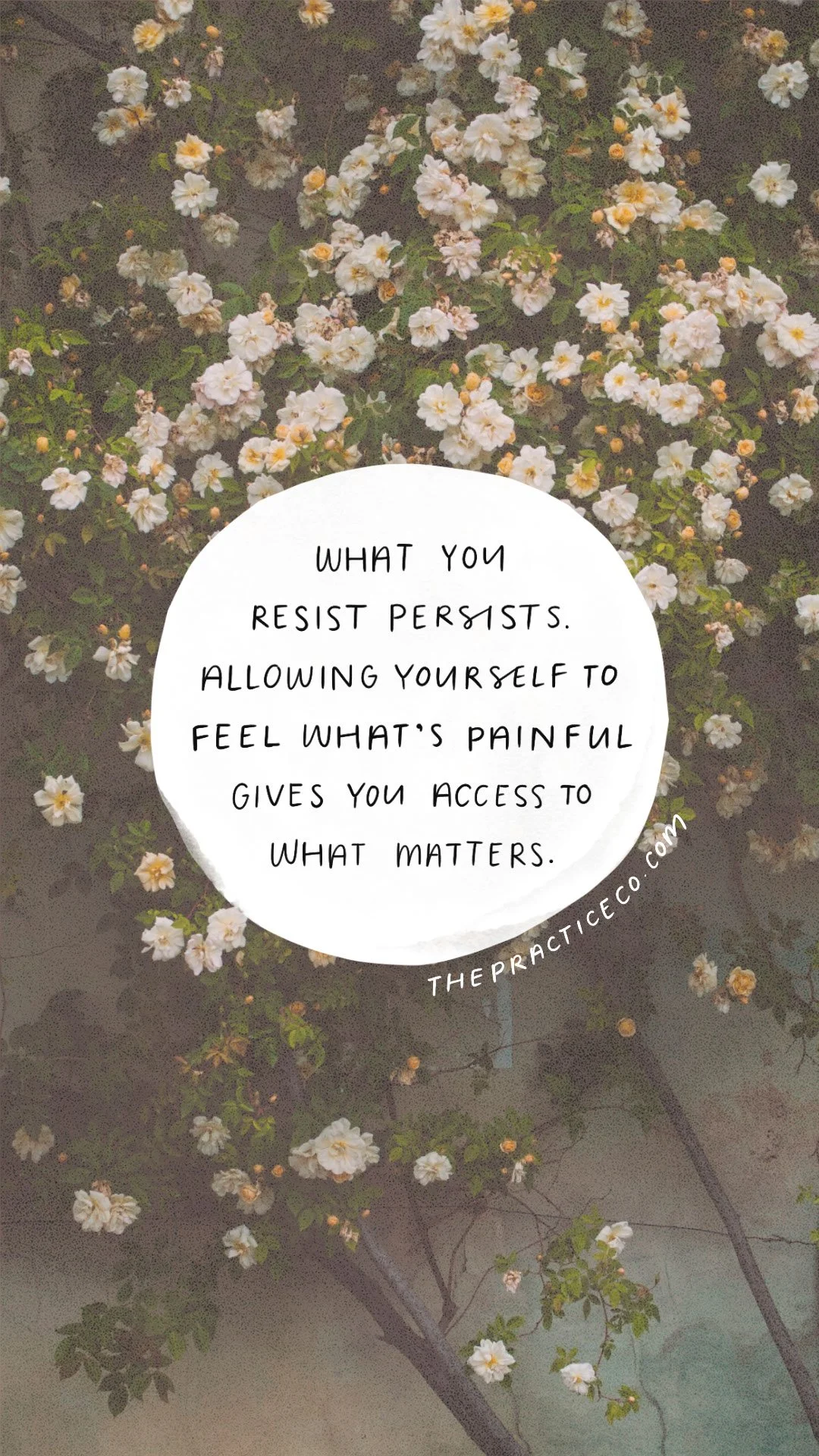
CONSIDER THIS: What you resist persists. Feeling what’s painful is what gives you access to what matters.
L xo