
The Art of Reframing
Many of the negative automatic stories we tell ourselves come from the resistance, and from being out of practice, of critical awareness.
In the gifts of Imperfections, Brené Brown said:
"Practicing critical awareness is about reality-checking the messages and expectations that drive the "never good enough" gremlins. From the time we wake up to the time our head hits the pillow at night, we are bombarded with messages and expectations about every aspect of our lives. From magazine ads and TV commercials to movies and music, we're told exactly what we should look like, how much we should weigh, how often we should have sex, how we should parent, how we should decorate our houses, and which car we should drive. It's absolutely overwhelming, and, in my opinion, no one is immune. Trying to avoid media messages is like holding your breath to avoid air pollution — it's not going to happen.
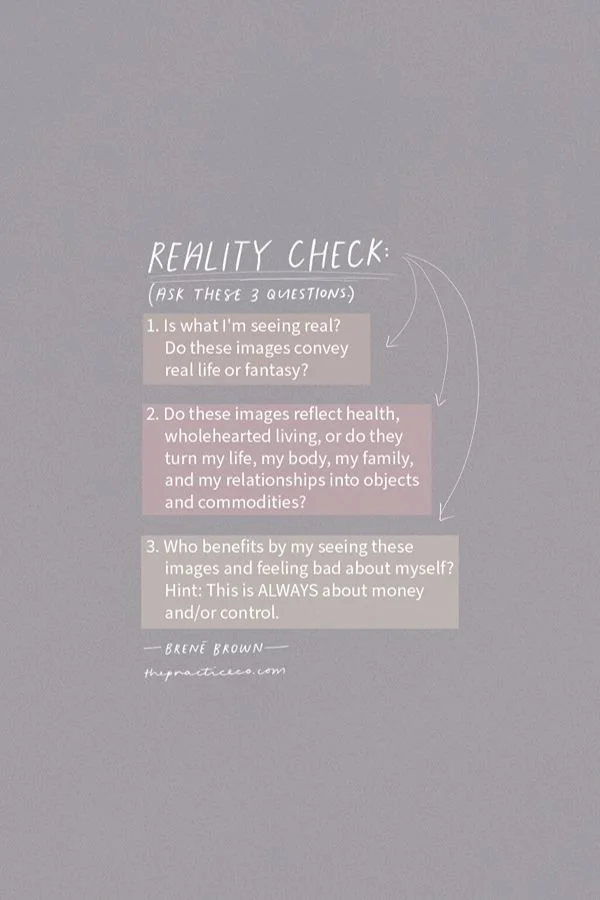
It's in our biology to trust what we see with our eyes. This makes living in a carefully edited, overproduced, and Photoshopped world very dangerous. If we want to cultivate a resilient spirit and stop falling prey to comparing our ordinary lives with manufactured images, we need to know how to reality-check what we see. We need to be able to ask and answer these questions:
1. Is what I'm seeing real? Do these images convey real life or fantasy?
2. Do these images reflect health, wholehearted living, or do they turn my life, my body, my family, and my relationships into objects and commodities?
3. Who benefits by my seeing these images and feeling bad about myself? Hint: This is ALWAYS about money and/or control."
What I find falls short in body positivity concepts is that we're still practising image-based value. Yes, we're trying to widen the boundaries of what is considered a "beautiful image," and I am all for that and practice it in my life. We're still focusing on what our bodies look like, what our faces and hair and nails and eyebrows and clothing and all of that look like without deconstructing the idea of where our value comes from in the first place. When we address the value base first, our practices of body image celebration will flow from that value, and most likely with less force, fear, and anxiety.
Critical awareness about the comparisons, pressures and expectations that we put on ourselves that end up fuelling the never "never good enough gremlins (the negative automatic narratives), is part of the work of reframing.
The great thing about critical awareness is that it makes even the most difficult and confusing issues seem possible to figure out. It gives you a practical framework to deconstruct any negative messaging - Brené's three questions above are a great framework - and figure out what it's doing to you and how you could change it.
I used Body positivity as an example above because it's one that's practical for me: I have been working my way out of a relapse into a pattern of dysmorphia and have been learning to examine and re-write my value around my body to address the root of the problem (which isn't me - a nod to part 2). The narrative around what makes a woman (in my case, but also a man or a them) valuable is the problem here. Critical Awareness enables us to reality-check these values and stories, and re-author new narratives to support a more holistic, enriching, and life-affirming story.
Confusion and the belief that you aren't smart enough or capable of figuring a problem out is where critical awareness is particularly helpful. You start by examining what you do know, what you think you know, and asking questions like the ones Brené has posited above. You will find out that you do know, you can figure it out, and you are capable. That, in itself, is part of the reframe.
Reframe: This is above my pay grade; I'll never figure this out; this is too hard for me, with: I am inherently creative, inbuilt with problem-solving mechanisms, and the ability to tease apart challenges.
Liz xo