
The Courage to Change Your Mind
Nobody tells you that the hardest part isn’t leaving.
The hardest part is what comes after. The open space where the old certainty used to live. The silence where the answers used to be. The strange, suspended feeling of being someone who has put something down and not yet found what comes next. Of being, in the most literal sense, in between.
We are not good at in between. We are a culture of arrivals. Of before and after photographs. Of transformation narratives that move cleanly from crisis to resolution, from doubt to clarity, from broken to healed, with a tidy arc and a lesson learned by the final page. We love a destination. We are deeply uncomfortable with the journey, particularly the part of the journey where you don’t know where you’re going yet.
But the in between is not empty. It only feels that way because we’ve been taught to measure our progress by how much we’ve figured out, and in the in between, you haven’t figured out much at all. You are just there. Present to the uncertainty. Alive inside the question.
Rainer Maria Rilke wrote, in a letter to a young poet,
“I would like to beg you, dear friend, as well as I can, to have patience with everything that remains unsolved in your heart. Try to love the questions themselves, as if they were locked rooms or books written in a foreign language. Don’t search for the answers, which could not be given to you now, because you would not be able to live them. And the point is, to live everything. Live the questions now. Perhaps then, someday far in the future, you will gradually, without even noticing it, live your way into the answer.”
Live your way into the answer. Not think your way. Not pray your way or perform your way or discipline your way. Live. Which requires time, and presence, and a willingness to stay with the not-knowing long enough for something genuine to emerge from it.
This is the practice nobody assigns you in church, or school, or therapy, or the self-help section of any bookshop. The practice of sitting with an open question and not immediately trying to close it. Of letting the uncertainty be uncertainty, rather than rushing to resolve it into something more manageable. Of trusting that the ground will become solid again without needing to know exactly when.
I spent years terrified of my own questions. Trained to believe that doubt was the opposite of faith rather than its companion. That not knowing was a problem to be solved rather than a space to be inhabited. So I filled the silence with activity, with service, with theological gymnastics, with being useful enough that nobody, including me, would notice that underneath it all I had absolutely no idea what I actually believed anymore.
What I know now is that the questions were never the threat. The rushing to answer them was.
Toko-pa Turner writes that,
“belonging begins with befriending the unknown in ourselves.”
And I think this is exactly right. The parts of us that don’t know yet are not the parts that need to be fixed or silenced or hurried along. They are the parts that are still becoming. Still listening. Still open to something that the certain, resolved, already-arrived version of us would never have been able to receive.
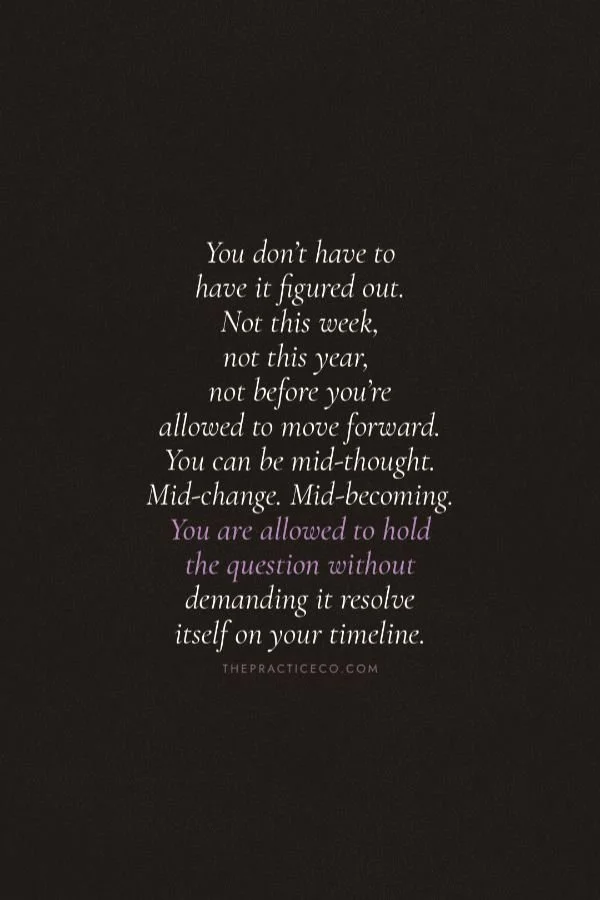
You don’t have to have it figured out. Not this week, not this year, not before you’re allowed to move forward. You are allowed to be mid-thought. Mid-change. Mid-becoming. You are allowed to hold the question without demanding it resolve itself on your timeline.
The not-knowing is not a waiting room. It is the work itself.
MINDFUL MOMENT: Sit with one question you’ve been trying to answer. Just for today, resist the urge to resolve it. Notice what it feels like to let it be open. Notice what the question is actually asking of you underneath the urgency to close it.
L xo