
A Loop of Faith
So tell me — is it a leap of faith? Or a loop of confirmation bias keeping you from the pain of cognitive dissonance?
Over the twenty-five-plus years I was involved in Pentecostal church — from pastor’s kid to pastor — those two got mixed up constantly. What the community called faith was often a shortcut. A religious framework that needed to stay unchanged, to stay in control. Questions were lack of faith. Inclusion was twisted faith. Doubt was broken faith. Illness was weak faith. Science was the opposite of faith entirely.
I grew up knowing things in my mind that contradicted what I knew in my bones. Things about the nature of worth, the shape of the world, the origins of love. The faith of my community seemed to put a fence around everything — a boundary beyond which curiosity wasn’t permitted, where an expansive, generative love couldn’t quite breathe. The loop kept things tidy. The loop kept things safe. And the loop kept me from myself for a very long time.
I wonder how much of what we call faith is actually confirmation bias — built on assumptions of belonging and believing, reinforced by communities that need us to keep agreeing in order to hold their shape.
I wonder how much of belief is a house of cards, one honest question away from beginning to shift.
I wonder how much of it is our minds cooking the books — making the evidence cooperate so we can feel worthy, right, loved, and certain all at once.
Things change when we stop asking faith to be something it was never meant to be.
Alan Watts drew a distinction I keep returning to:
“We must here make a clear distinction between belief and faith, because, in general practice, belief has come to mean a state of mind which is almost the opposite of faith. Belief, as I use the word here, is the insistence that the truth is what one would ‘lief’ or wish it to be. The believer will open his mind to the truth on condition that it fits in with his preconceived ideas and wishes. Faith, on the other hand, is an unreserved opening of the mind to the truth, whatever it may turn out to be. Faith has no preconceptions; it is a plunge into the unknown. Belief clings, but faith lets go. In this sense of the word, faith is the essential virtue of science, and likewise of any religion that is not self-deception. Most of us believe in order to feel secure, in order to make our individual lives seem valuable and meaningful. Belief has thus become an attempt to hang on to life, to grasp and keep it for one’s own. But you cannot understand life and its mysteries as long as you try to grasp it. Indeed, you cannot grasp it, just as you cannot walk off with a river in a bucket. If you try to capture running water in a bucket, it is clear that you do not understand it and that you will always be disappointed, for in the bucket the water does not run. To ‘have’ running water you must let go of it and let it run.”
Belief clings. Faith lets go.
I spent so many years clinging. To certainty, to belonging, to a version of God that would stay still long enough for me to feel safe. What I was protecting wasn’t faith. It was the story I needed to be true so I could keep going.
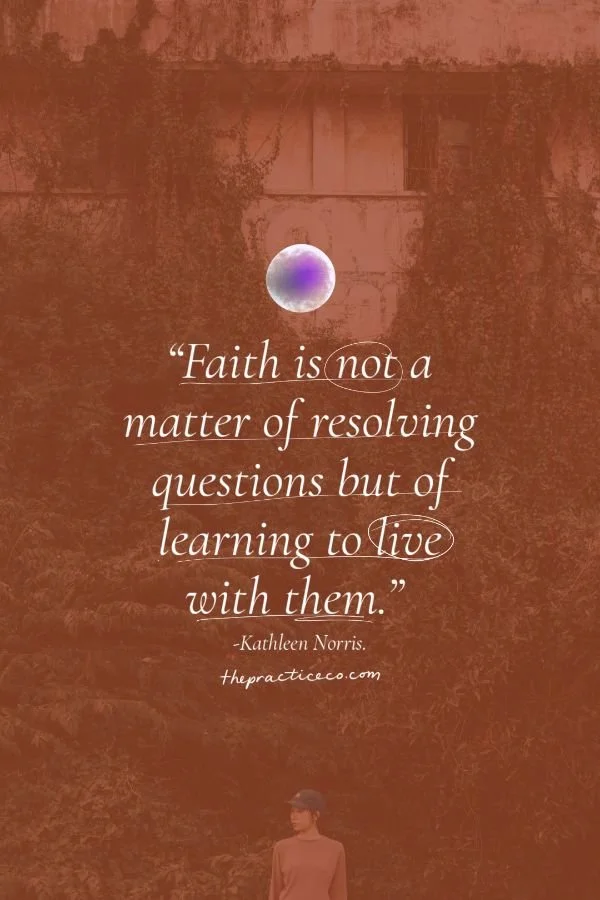
Kathleen Norris wrote that
“faith is not a matter of resolving questions but of learning to live with them.”
That’s the shift. Not from doubt to certainty, but from the exhausting performance of certainty to the quieter, steadier practice of staying open. Staying curious. Letting the water run.
What is faith when it’s unwound from the need to be right? What is faith when it no longer has to protect itself?
That’s not a rhetorical question. It’s the one worth sitting with.
JOURNAL PROMPT: What have you been calling faith that might actually be fear of the questions? And what might open up if you let yourself ask them anyway?
Liz, xo