
The Tyranny of Wholeness
It happened on a Tuesday night.
Nothing dramatic. No revelation. Just a kitchen with the lights too bright, a child asking for water again, dishes stacked beside the sink, music playing from someone’s phone while pasta boiled over. Halfway through stirring the sauce, I noticed my shoulders had dropped. The room had not changed, and yet something in me had.
No one had named my nervous system. No one had coached my breathing. No one had invited me to excavate my childhood. My body, the same one that has known panic, vigilance, old grief… had softened anyway.
Not because it had been analysed. Not because it had been prayed over. And not because I followed someone’s 7-point plan…
Because it had been allowed to live amongst the mess, amongst the unfinished things, with the things that weren’t complete and perfect… and maybe, just maybe, because I had learned that healing was not a pre-requisite for enjoying your life.
We are trained to look for healing in exceptional places. Therapy rooms, retreats, early-morning journals, long walks where insight arrives like a flare in the dark. Those spaces matter. They can be sacred. But when healing becomes something we only recognise inside intentional practices, we risk missing how often it is happening while we are busy being ordinary.
People who have spent years monitoring themselves can find this idea almost offensive. Surely regulation must be earned through discipline and precise inner work. Surely safety arrives through vigilance. And yet bodies so often relearn trust through experiences that do not announce themselves as spiritual at all — the rhythm of cooking again, the warmth of a mug in cold hands, the familiar route home, the way a song loosens something you did not realise was clenched.
Hilary McBride returns again and again to this truth, that bodies learn through lived encounter rather than explanation. In The Wisdom of Your Body, she writes,
“Our bodies learn what is true through experience, not just through insight.”
The sentence feels almost too simple until you notice how rarely we let ourselves believe it.
If experience is the teacher, then healing is happening in far more places than we give it credit for. It unfolds while you parent imperfectly, while you flirt badly, while you keep a promise to yourself, while you do work that absorbs you long enough to forget your own interior commentary. It unfolds in the moment you stay at the table rather than retreating, in the argument that ends with repair instead of silence, in the walk you take because the air feels good rather than because it is prescribed.
What makes these moments holy is not their grandeur. It is their repetition. They teach the body what safety feels like through consistency rather than spectacle. They widen the nervous system’s tolerance for pleasure and connection without making a show of it.
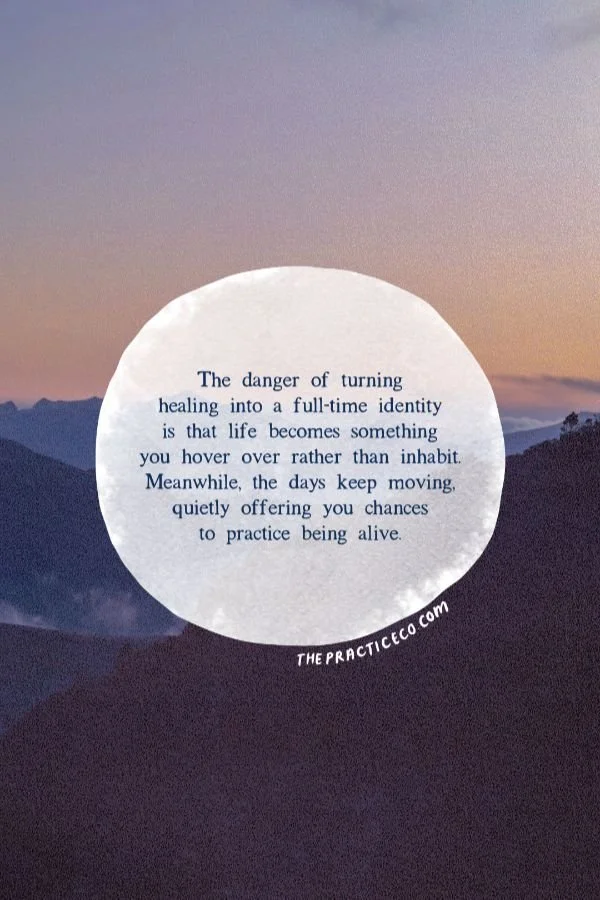
The danger of turning healing into a full-time identity is that life becomes something you hover over rather than inhabit. You narrate your reactions. You assess your capacity. You wait for internal weather systems to clear before you commit to anything too real. Meanwhile, the days keep moving, quietly offering you chances to practice being alive.
Healing often does not arrive as a dramatic shift.
It shows up as increased room.
You notice that you can stay present in conversations that once sent you spiralling. You recover more quickly after conflict. You sleep better. You make plans without interrogating your readiness. You laugh before checking whether you should. You feel pleasure without immediately needing to justify it.
This is what spiritual formation looks like when it leaves the mountaintop and comes home. Not transcendence for its own sake, but presence. The slow, stubborn work of teaching a body that this moment is survivable, that connection is possible, that delight does not need to be earned, that your life is not waiting at the far end of healing but unfolding right here.
CONSIDER THIS:
Where in your ordinary week does your body soften without effort?
What might change if you trusted those moments as part of your healing rather than interruptions to it?
Always,
L xo