
Tired of healing?
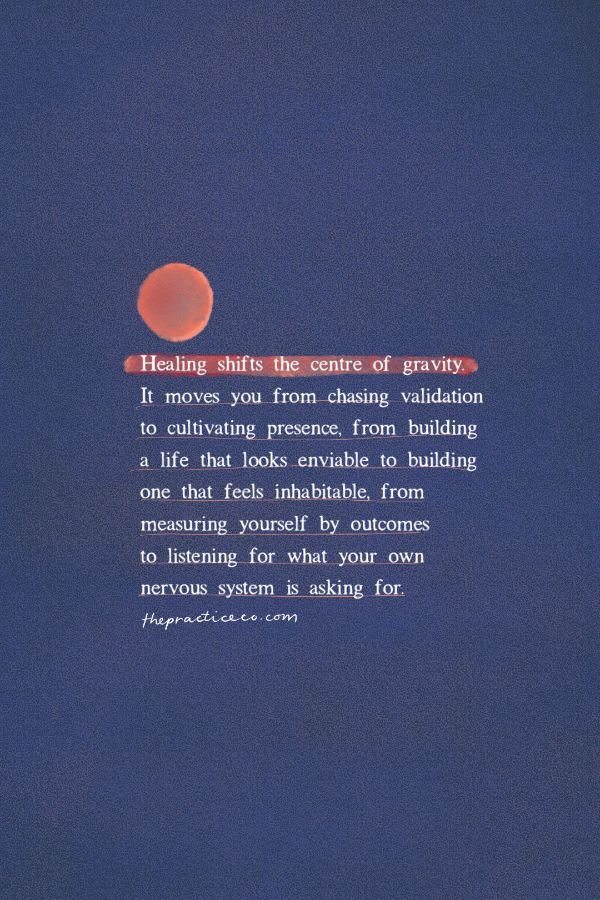
When I first started writing this series, I kept noticing the same sentence surfacing in conversation after conversation.
“I just need to fix this first.”
It showed up in therapy rooms. At café tables. In quiet confessions from people who have read everything, tried everything, named everything, and were still unsure whether they were allowed to want much yet. It arrived dressed as wisdom, responsibility, maturity, spiritual depth. But underneath it I could hear something heavier: a life being paused in the name of improvement.
I mean, I’ve caught myself saying it, too.
That tension is what gave birth to The Tyranny of Wholeness.
This series has not been an argument against healing. Far from it. I believe in therapy. I believe in trauma-informed language. I believe in tending to nervous systems, telling the truth about our histories, learning new ways to live in our bodies. Those practices have saved my life more than once.
What I have been questioning instead is the quiet way healing can become another finish line. Another invisible standard. Another place we measure ourselves and come up short. Another system that whispers that we should be further along by now.
Across these pieces, I’ve tried to name how easily wholeness becomes a fantasy of arrival, how spiritual and therapeutic language can slide into a new form of moral pressure, how unfinished starts to sound like failure. I’ve tried to hold space for the reality that many of us left rigid religious systems only to rebuild similar architectures inside ourselves, trading sin for symptoms, obedience for insight, purity for regulation, while keeping the same ladder underneath.
What I wanted to keep returning to was a simpler, harder truth: that healing was never meant to replace your life.
It was meant to accompany it.
In the series we circle this idea from different angles. How the body often relearns safety through ordinary days rather than extraordinary breakthroughs. How desire returning is frequently one of the first signs of recovery, not a betrayal of the work. How learning to live with unfinished places can be a form of maturity rather than defeat. How shame grows in secrecy, and how connection keeps widening what fear tries to shrink. How healing as a full-time identity can quietly narrow a future, while healing woven into vocation, creativity, love, parenting, friendship, work, risk and joy tends to expand it.
Hilary McBride has been a steady companion in this conversation, especially when she writes,
“Healing is not about becoming someone new; it is about becoming more fully who we already are.”
That line refuses both despair and perfectionism. It suggests that the work does not strand us inside ourselves but sends us back into the world with more agency, more tenderness, more courage than we had before.
Mary Oliver presses in the same direction when she asks, “Tell me, what is it you plan to do with your one wild and precious life?” She does not ask after readiness. She assumes participation.
And Julian of Norwich, writing from within illness and instability, insisted, “All shall be well, and all shall be well, and all manner of thing shall be well.” Her hope did not come from a denial of pain. It came from trusting that love could hold what was broken without waiting for the world to become gentle first.
That is the kind of wholeness this series has been circling.
Not polish.
Not completion.
Not a pristine interior life.
Something wider. Something sturdier. A self capable of living in public while still healing in private. A life large enough to carry history without letting it become the only plotline.
I don’t know who this series found, or where you encountered it — whether you read every part slowly, or stumbled across a line that lodged itself in your chest, or recognised yourself in a sentence you weren’t expecting to. What I do know is that many of us are tired. Tired of preparing to live. Tired of treating tenderness as disqualification. Tired of waiting for an internal certificate of readiness that never quite arrives because life keeps unfolding and asking things of us anyway.
If that is you, then this series was written with you in mind.
Not to rush your healing.
Not to minimise your pain.
But to widen your imagination about what is possible while the work is still ongoing.
If healing has become the place you keep waiting, I hope these pieces felt like an invitation out — into a life that doesn’t need or want perfection.
The full Tyranny of Wholeness series is now live inside The Practice Co.
L xo